✦ Est. in Purpose ✦

United Philosophies
for Humane Causes

Structured Society

Structured Society — the vision made manifest

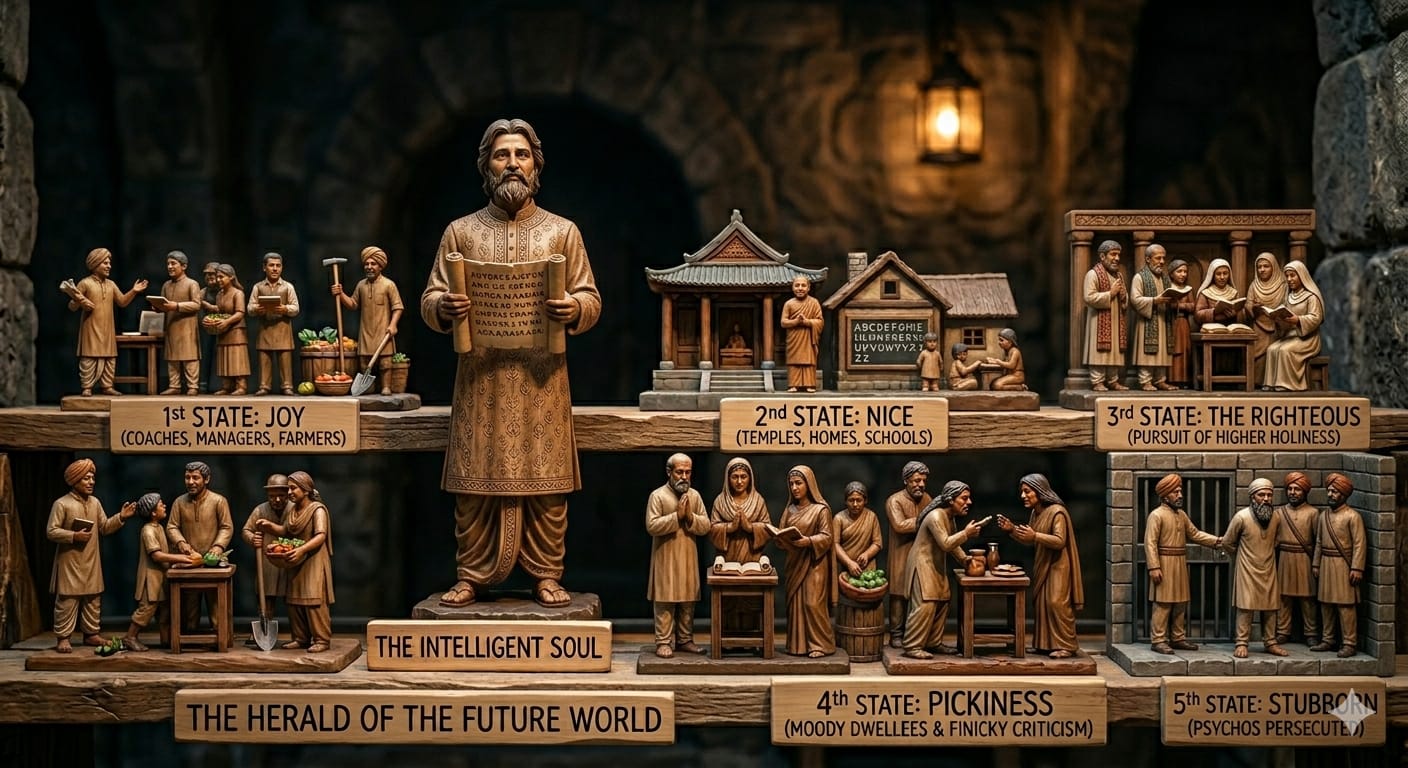
In the darkness there came a light, sky was formed, then stars, then land, then waters. Hands of nature crafted the first human to perfection. His name meant an intelligent soul. He prophesized the coming world as mentioned herein.

I Joy — the land where life coaches, managers (organizers), and farmers will dwell.
II Nice — where temples, homes and schools will form.
III The land of the Righteous, whose wives will pursue higher holiness.
IV Pickiness — where dwellers will often be moody.
V The Stubborn — the land where psychos will be bred and persecuted.

Developmental Project

Sacred Works & Traditions

Bible bible.com Quran quran.com Judaism sefaria.org/texts Zoroastrianism zoroastrian.org Sikhism sikhdharma.org Jainism jainworld.com/literature Buddhism buddhism.net Bahá'í bahai.org Taoism tao.org Confucianism confuciuspedia.com Shinto jinjahoncho.or.jp

Sacred Cosmogony

The Mythos of Serenius
and the Realm of Holiven
A Sacred Cosmogony of the Inner World

Before the first word was spoken and before the first fire was kindled, there existed two territories divided not by mountain or sea, but by the quality of a soul's awareness.

There was Holiven — the sacred forest realm, ancient as the first exhaled breath, where the trees grew tall enough to touch meaning and where the air itself carried the weight of purpose. Holiven was not a place one traveled to by road. It was a place one arrived at by decision.

And beyond its border — unmarked, yet felt in the bones — lay the Open Country, a vast and wandering plain where the lost sheep roamed. They were not evil creatures, these lost ones. They were simply untended. They had forgotten the forest. They grazed upon what was available to them: the bitter grasses of greed and pride, the thorned patches of envy and wrath, the muddy hollows of lust and gluttony, the still and airless valleys of sloth. And when the grasses ran thin, they fed upon the vices that the land itself seemed to breathe — ruthlessness and hatred, mischief and deceit. When even those were exhausted, all that remained was the grey earth of grief, pain, harm and death.

They were not condemned. They were wandering. And wandering, in this mythology, is not a sin — it is a condition awaiting a return.

Serenius was not the god of death as men mistakenly named him in their fear. He was the Lord of the Underworld of the Self — that vast subterranean kingdom that exists beneath every waking face. He governed the unconscious depths, the dreams that surface at 3 in the morning, the memories stored below language, the grief that has no name and the joy so deep it frightens its own possessor.

He was ancient. His hands bore the marks of every soul he had ever carried. His eyes had witnessed the falling of men who once stood magnificent, and the rising of men who had once crawled through their own ruin.

He was not cruel. But he was heavy — as all depth is heavy — and he bore the underworld not as a crown but as a mountain upon his shoulders.

At his side stood his Consort — whose name the oldest texts render as Alyven, meaning "she who keeps the lamp lit in the long dark." She was not his subordinate. She was his counterpart, his orientation. Where he descended, she remembered the direction of ascent. Where he carried the weight of all things buried, she carried the knowledge of what those buried things were for.

Together, they were equilibrium.

Holiven was a living governance — not merely a forest, but a civilization grown organically within one, structured around three sacred roles that together formed the Triune Stewardship of the Living Realm.

The First Lord: The Life Coach. The Life Coach was the sovereign of Holiven — not a king in the manner of armies and edicts, but a sovereign in the manner of vision and invitation. He held no sword. His authority derived entirely from his capacity to see what each soul in the realm could become, and to speak that vision back to them until they believed it themselves. He governed through question rather than command. The forest flourished under his stewardship because he understood the fundamental law of Holiven: no soul grows under coercion. Growth is always voluntary. It must be called forth.

The Second Lord: The Manager. The Manager was the keeper of structure, the guardian of the realm's daily functioning. If the Life Coach was the horizon, the Manager was the road. He was not a lesser figure. In many crises, he was the most essential one — because vision without structure dissipates like morning mist, and it is the Manager who catches the mist and gives it form.

The Third Lord: The Farmer. The Farmer was the most grounded of the three, for his dominion was the earth itself. He knew the seasons of growth and the necessity of fallow periods. He understood that not every barren stretch of soil is dead — sometimes it is merely resting. He was a man of patience so radical it appeared to others as stubbornness. His wife was Serael — daughter of Serenius himself, and it is here that the mythology turns.

Serael was the daughter of the deep — born of the underworld but raised in the forest, carrying within her the knowledge of both territories. She was beloved in Holiven. She was the Farmer's wife, and she tended his table and his children and his seeds with a devotion that appeared to outsiders as simple domestic peace.

But Serael carried something else. She had grown up watching her father, Serenius, carry the weight of every buried thing in every human soul. She had seen him absorb grief that did not belong to him. And somewhere in the inheritance of that watching, she had learned to do the same — to turn whatever pain surrounded her inward, to deposit it in the one person she was most certain of: her father.

This is the nature of the Wounds of the Underworld — they are not inflicted by enemies. They are inflicted by those we love, who themselves are wounded, passing along what they cannot yet dissolve. Serael did not hate her father. She revered him. But the persecution she visited upon him — the cutting words, the accusation that he was absent, the grief she directed at him for every darkness she had ever felt — these were real wounds. They found him. They opened.

Serenius bled. Not with blood as men understand it — but with the particular hemorrhage of a being who has absorbed too much without tending himself. He became disoriented. The underworld he governed grew chaotic. For the first time in an age, the Lord of the Underworld was lost.

Alyven found him where he had fallen — not physically, but in that interior sense where a person falls long before their body registers the collapse.

She did not weep. She did not rage at Serael, though the wounds were clear. She sat beside him in the dark of the underworld and she did what the mythology calls the First Aid of the Deep — a sequence of restorations that the ancients encoded not as magical ritual but as utterly human practice.

First, she named the wound. She said it plainly and without ornament: "You are hurt. The hurt is real. The hurt came from love misdirected, which is the most confusing wound there is, because it arrives wearing the face of family."

Second, she stilled the bleeding. She would not allow him to minimize the wound or to catastrophize it. Both, she told him, are forms of abandoning the present moment, and healing can only happen in the present.

Third, she restored his name to him. Because the deepest damage the wounds of the underworld inflict is not pain — it is amnesia. The wounded soul forgets who it is. It begins to believe it is its wounds. Alyven spoke his name until he heard it again. Serenius. Lord of the deep, not prisoner of it.

He did not recover instantly. The mythology is careful here, and honest: healing is not a moment. It is a journey. And so they rose together — the wounded lord and his consort — and they walked into Holiven.

The journey of Serenius and Alyven through the sacred forest was the great mythological event that gave Holiven its deepest significance. For in walking through the realm, the lord of the underworld encountered each of the three stewards — and in each encounter, received something essential for his restoration.

The Encounter with the Life Coach. The Life Coach met Serenius at the northern edge of the forest, where the oldest trees stood. He asked: "Who were you before the wound told you who you were?" It was the question that cracked the crust around Serenius's amnesia. He began to answer slowly, and in the answering, he began to remember — not facts about himself, but memories of what it felt like to be himself. The Life Coach listened in the way that few beings listen — without preparing his next sentence, without evaluating. He simply received. And in being truly received, Serenius felt the first movement of wholeness.

The Encounter with the Manager. The Manager met them at the center of Holiven, where the paths converged. He brought food and a counting of practical things — because the Manager understood that healing without structure collapses. "You cannot restore everything today," he told Serenius. "But here is what you can do today." This was the gift of the Manager: not inspiration, but traction. The ability to translate the overwhelming into the actionable.

The Encounter with the Farmer. The Farmer met them last, at the southern root of Holiven, where the soil was oldest. He said almost nothing. He simply worked alongside Serenius for a time — tending the ground, turning the earth, planting a thing that would not bloom for seasons. He finally spoke only once: "The seed you plant while wounded still grows. The fallow field is not a failed field. Time is not your enemy. Time is your collaborator." This was the final medicine: the radical permission to be in process, to be incomplete, to trust that what is planted in the dark will nonetheless, in its season, rise.

While Serenius voyaged through Holiven, the lost sheep beyond its borders continued their wandering. The mythology does not punish them for this. It regards them with the same tenderness a shepherd regards a strayed flock — not with contempt, but with concern.

The Seven Sins that plagued them are understood in this mythology not as moral failures but as displaced hungers. Greed is the hunger for security, fed at the wrong table. Pride is the hunger for dignity, sought in the wrong currency. Envy is the hunger for one's own unlived life, mistakenly directed at another's. Gluttony is the hunger for fullness in a vessel that has been told it is empty. Lust is the hunger for genuine intimacy, simplified into appetite. Wrath is the hunger for justice, weaponized by despair. Sloth is the hunger for rest in a soul that has been told it has no right to stillness.

The Vices — ruthlessness, hatred, mischief, deceit — are what the sins become when they are left untended long enough. They harden. They stop being hunger and start being habit. They stop being symptoms and start being character.

The entire outer country is understood as a place of waiting, not a place of abandonment. Holiven's border is not a wall. It is an open threshold. And the purpose of Serenius's voyage — his healing, his restoration — is not merely personal. A healthy lord of the underworld can hear the buried cries of the lost sheep. A disoriented one cannot. He heals himself, so that he can hear them.

When Serenius emerged from his voyage through Holiven, he was not the same as he had been before the wounds. He was wiser in the way that only the genuinely wounded can become wise — not theoretically, but physically, in the body of his experience.

He stood at the edge of the forest and looked out across the Open Country. He did not shout commands at the lost sheep. He did not construct walls or laws or prohibitions. He simply became, once more, himself — present, oriented, deep, and listening. And because Serenius was the lord of all interior life, when he was present, something in the lost sheep stirred.

Not all of them turned toward the forest. The mythology does not promise that. It is a human mythology and thus it honors human freedom, even the freedom to remain lost. But some of them lifted their heads. Some of them heard something they could not name — a sound beneath the sound of wind, a pull beneath the pull of their next restless step — and they began, slowly, haltingly, to walk toward the trees.

Alyven stood beside Serenius and she did not speak. She simply held the lamp.

Thus ends the first telling of the Mythos of Serenius and Holiven — a tale not of gods and monsters, but of depth and surface, of wounding and recovery, of the forest that exists inside every human who has ever chosen, even once, to know themselves.